Landline Phone:
(413) 214-6541
Location:
15 Agawam Ave West Springfield, MA 01089
Mon - Fri:
8.00am - 4.00pm
UOA (Used Oil Analysis): The Foundation of Predictive Maintenance
In modern industrial operations, “changing the oil” based on a calendar date is an outdated and expensive practice. Whether you are managing a fleet of haul trucks, a series of industrial gearboxes, or a massive power generation turbine, the most effective way to manage your lubricants is through UOA (Used Oil Analysis).
At Sterling Analytical, our Oil Analysis Laboratory provides a comprehensive window into the internal environment of your machinery. UOA is the science of analyzing a lubricant’s physical and chemical properties to determine three critical factors:
- The Condition of the Oil: Is the lubricant still capable of protecting the machine?
- The Presence of Contaminants: Has dirt, water, or the wrong oil entered the system?
- The Health of the Machine: Are wear metals indicating an imminent mechanical failure?
By implementing a rigorous UOA program, companies can shift from reactive “break-fix” maintenance to a proactive, Condition-Based Monitoring (CBM) strategy that saves thousands in avoided downtime and lubricant costs.
1. The Three Pillars of Used Oil Analysis
A professional UOA report from Sterling Analytical is divided into three distinct categories of data. Understanding how these pillars interact is the key to interpreting your results.
Pillar I: Fluid Chemistry (Oil Condition)
Lubricants don’t last forever. Over time, heat, pressure, and oxygen cause the base oil and its additive package to degrade.
Oxidation: The chemical reaction between the oil and oxygen, accelerated by heat. Oxidation leads to the formation of sludge, varnish, and organic acids.
Additive Depletion: Modern oils contain “sacrificial” additives (Anti-wear, Detergents, Dispersants). UOA tracks the levels of elements like Zinc (Zn), Phosphorus (P), and Calcium (Ca) to ensure the additive package is still active.
Viscosity: As discussed in our Engine & Motor Oil Analysis, viscosity is the most critical physical property. UOA monitors if the oil has thickened due to oxidation or thinned due to shear or contamination.
Pillar II: Contamination (The "Foreign" Elements)
Contamination is the leading cause of lubricant-related failure. UOA identifies what has “invaded” the system:
Water: The most destructive contaminant after dirt. It causes rust, promotes oxidation, and can lead to oil “foaming.”
Silicon (Dirt): Microscopic sand and dust that act as an abrasive, grinding down metal surfaces.
Cross-Contamination: Identifying if a different type of oil (e.g., hydraulic fluid in a gearbox) has been added, which can lead to additive clashing and loss of protection.
Pillar III: Wear Metals (Machine Health)
This is the “diagnostic” part of UOA. By measuring the ppm (parts-per-million) of specific metals, we can tell you which part of your machine is wearing out.
Iron (Fe): Gears, bearings, shafts.
Copper (Cu): Bushings, thrust plates, oil coolers.
Lead (Pb): Bearing overlays.
Aluminum (Al): Casings, pistons, or certain types of bushings.
2. Spectrometric Analysis (ICP-OES): The 24-Element Scan
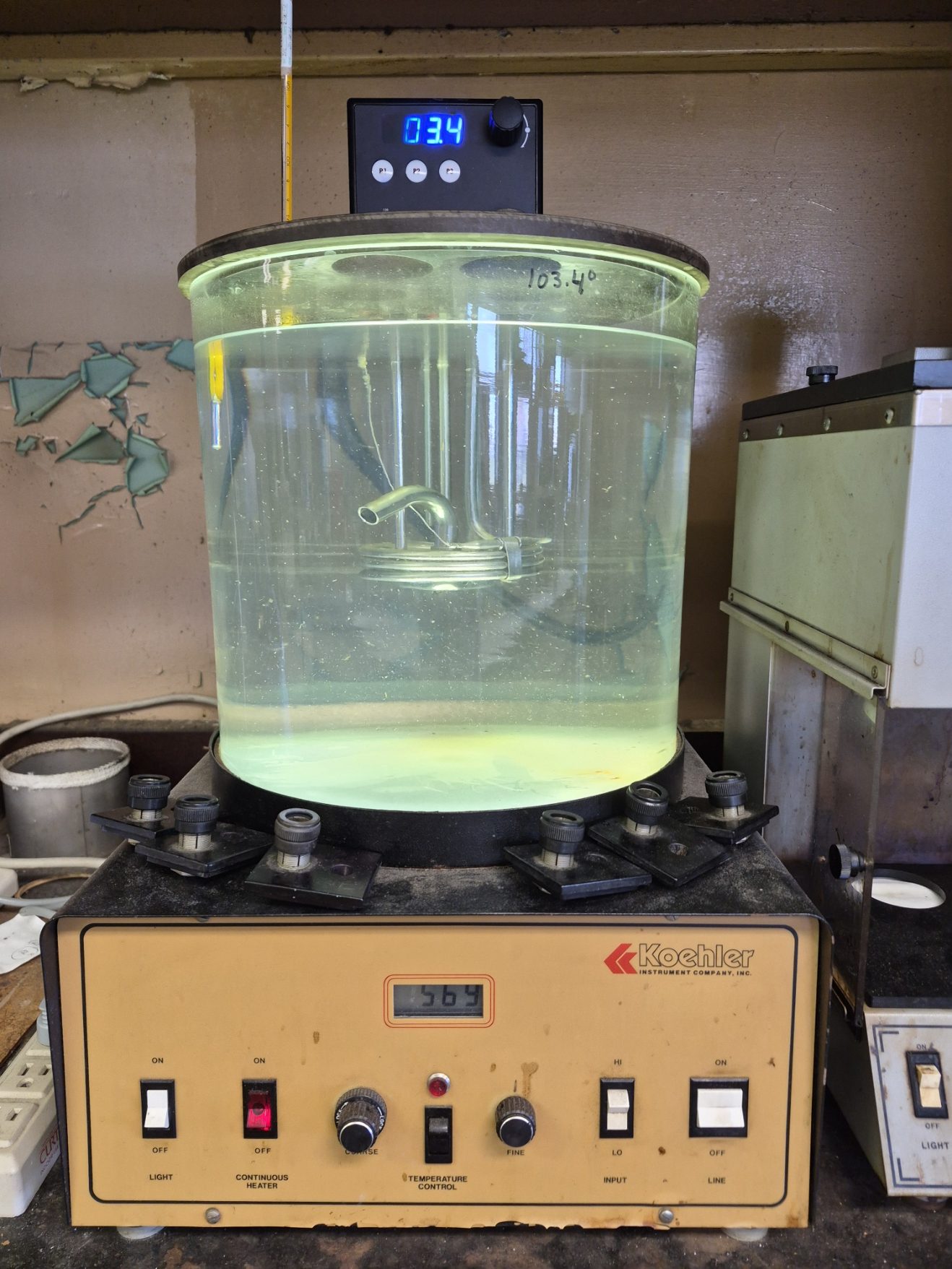
The heart of our Oil Analysis Laboratory is the Inductively Coupled Plasma (ICP) spectrometer. This instrument allows us to detect and quantify up to 24 different elements simultaneously.
How ICP Works
A small portion of your used oil sample is “nebulized” into a fine mist and injected into a plasma flame at $10,000^\circ C$. Each element in the oil emits a specific light frequency. By measuring the intensity of that light, we can determine the exact concentration of wear metals, contaminants, and additives in ppm.
Why Particle Size Matters
It is important to note that standard ICP analysis is most effective for particles smaller than 8 microns. This makes it an excellent tool for detecting “normal” wear and chemical changes. However, if a machine is undergoing a catastrophic failure, it may produce larger “chunks” of metal. This is why Sterling Analytical often combines ICP with Hydraulic Oil Analysis particle counting or Analytical Ferrography for a complete diagnostic picture.
3. Viscosity: The "Lifeblood" Metric
If you only perform one test on your oil, it should be Kinematic Viscosity (ASTM D445). Viscosity is the measure of the oil’s internal friction—its “thickness.”
Viscosity at $40^\circ C$: This is the standard measurement for industrial oils (ISO VG grades). It tells us how the oil performs at typical operating temperatures.
Viscosity at $100^\circ C$: This is the standard for automotive and engine oils (SAE grades). It tells us how the oil maintains its film strength under high-heat conditions.
The “Warning” Zones:
A 10% change from the “New Oil” baseline is a Cautionary flag.
A 20% change is a Critical flag, usually requiring an immediate oil change and investigation into the cause (oxidation, fuel dilution, or shearing).
4. FTIR (Fourier Transform Infrared) Spectroscopy
FTIR is a powerful “molecular” analysis tool. By passing infrared light through the used oil, we can “see” the chemical bonds of various compounds. This allows us to measure:
Oxidation: Measuring the “Carbonyl” peak to see how much the base oil has reacted with oxygen.
Nitration: Common in natural gas engines; it indicates a breakdown of the oil due to reaction with nitrogen oxides.
Soot: As detailed in our Engine & Motor Oil Analysis, FTIR is the standard for quantifying soot loading in diesel engines.
Glycol: Detecting the specific molecular signature of antifreeze, which is a death sentence for most industrial lubricants.
5. Water Contamination: The Karl Fischer Method (ASTM D6304)
While a simple “crackle test” can detect gross water contamination, industrial systems require the precision of Karl Fischer (KF) Titration. Water is the second most destructive contaminant in a lubricant, leading to:
Hydrogen Embrittlement: Water molecules migrate into the metal surface of bearings, causing microscopic cracking and premature fatigue.
Additive Hydrolysis: Water reacts with anti-wear additives (like ZDDP), breaking them down into acidic byproducts that can actually attack the metal they were meant to protect.
Microbial Growth: In systems with low turnover, water provides the environment for “oil-eating” bacteria to thrive, creating a thick, acidic slime.
At Sterling Analytical, we measure water in parts-per-million (ppm). For high-performance hydraulic systems or steam turbines, even 500 ppm (0.05%) can be a critical failure point. Our KF analysis provides the exact data needed to decide if a simple dehydration process is enough or if a full oil change is required.
6. Chemical Health: TAN vs. TBN
Understanding the acidity or alkalinity of a lubricant is the primary way to determine its remaining useful life.
Total Acid Number (TAN) - ASTM D664
TAN is the standard for industrial oils, including gearboxes, hydraulics, and turbines. It measures the concentration of acidic compounds in the oil.
The Trend: As oil oxidizes, the TAN rises.
The Limit: A significant increase in TAN (usually 0.5 to 1.0 above the “new oil” baseline) indicates that the oil is becoming corrosive and is prone to forming varnish and sludge.
Total Base Number (TBN) - ASTM D2896/D4739
As detailed in our Engine & Motor Oil Analysis, TBN is the metric for internal combustion engines. It measures the alkaline reserve used to neutralize combustion acids. When TBN drops, the engine is at risk of corrosive wear on the cylinder liners and bearings.
7. Particle Counting and ISO Cleanliness (ISO 4406)
For non-engine systems, the “cleanliness” of the oil is often more important than the wear metal ppm. This is the core of our Hydraulic Oil Analysis, but it is a standard part of any high-level UOA program.
We use laser particle counters to categorize particles into three size ranges: >4 microns, >6 microns, and >14 microns. This results in an ISO Cleanliness Code (e.g., 18/16/13).
The Goal: By monitoring the ISO code, we can tell you if your filtration system is failing or if external contaminants are entering the system through a faulty breather or seal.
8. The ROI of a UOA Program: Why It Pays for Itself
Implementing a Used Oil Analysis program is one of the highest-return investments a maintenance department can make.
Avoided Catastrophic Failure
The cost of a single UOA test is negligible compared to the cost of a catastrophic gearbox or engine failure. Identifying a $50 bearing wear issue before it turns into a $50,000 equipment replacement is the primary value of our laboratory.
Optimized Oil Drains
In large systems (100+ gallons), changing oil based on a schedule is wasteful. UOA allows you to safely extend the life of the lubricant. If the TAN is low, the viscosity is stable, and the additives are healthy, there is no reason to discard perfectly good oil.
Warranty Protection
For new equipment, regular UOA reports provide a “paper trail” of professional maintenance. If a component fails under warranty, your UOA data proves that the machine was operated within the correct lubricant parameters, preventing the manufacturer from denying the claim.
9. Sampling Procedures: The "Golden Rule" of UOA
The most common cause of “False Alarms” in oil analysis is poor sampling technique. To get the most out of your Oil Analysis Laboratory results, follow these steps:
Sample from the “Live Zone”: The sample should be taken while the oil is circulating and the machine is at operating temperature. Sampling from a dead-end pipe or the bottom of a cold sump will result in “sludge” that does not represent the actual oil condition.
Flush the Port: Always drain at least 1-2 liters of oil through the sampling valve before catching the sample in the bottle. This clears out any stagnant debris or moisture trapped in the valve itself.
Label Immediately: A sample without a label is useless. Include the machine ID, the oil type, the hours/miles on the oil, and the date.
Consistency: Use the same sampling point every time. If you change the sampling location, your “Trend Analysis” data will be skewed.
Integrated Oil Analysis Suite
UOA is the starting point for a total fluid management strategy. Explore our specialized services:
Engine & Motor Oil Analysis: Deep-dive testing for diesel, gasoline, and natural gas engines.
Hydraulic Oil Analysis: Focus on particle counting and high-pressure system reliability.
Transformer Oil Sample Analysis: Specialized testing for dielectric strength and dissolved gas analysis (DGA).
Frequently Asked Questions
UOA is the "umbrella" term for all used oil testing. Engine & Motor Oil Analysis is a specialized subset of UOA that focuses on combustion byproducts like soot and fuel dilution.
At Sterling Analytical, our standard turnaround time is 24-48 hours from the moment the sample arrives at our laboratory. Critical samples can be expedited for same-day results.
Yes. By looking at the Viscosity and the Additive Fingerprint (Zinc, Phosphorus, Magnesium, Calcium), we can identify if a hydraulic oil has been topped off with a gear oil or if a synthetic oil has been mixed with a mineral oil.
While Silicon usually means dirt, it can also come from Silicone Anti-Foam additives or recent maintenance where silicone-based gaskets or sealants were used. Our technicians look at the ratio of Silicon to Aluminum to distinguish between "Dirt" and "Sealant."
Quick Contact
If you have any questions or need help, feel free to contact with our team.
Send Us Email:
Call Us Today: