Landline Phone:
(413) 214-6541
Location:
15 Agawam Ave West Springfield, MA 01089
Mon - Fri:
8.00am - 4.00pm
pH & Conductivity Analysis Services
Related Posts
Sterling Analytical provides high-precision pH and conductivity analysis services as the foundational metrics for water quality, industrial process control, and environmental health. These two parameters are the most frequently measured indicators in wet chemistry, providing immediate insight into the chemical activity and ionic strength of a solution. Our laboratory supports municipal water authorities, industrial manufacturers, and environmental consultants with certified data used to ensure regulatory compliance and optimize chemical dosing.
Through calibrated electrometric methodologies (ASTM and EPA standards), our pH and conductivity testing services deliver the accuracy required for sensitive applications, from high-purity boiler feed water to complex industrial effluents. If you are searching for a water quality testing lab near me to evaluate acidity or mineral content, Sterling Analytical offers the technical expertise and rapid turnaround times necessary to maintain operational efficiency and environmental stewardship.
The relationship between pH and conductivity is a primary driver of chemical equilibrium. pH measures the hydrogen ion activity (acidity or alkalinity), while conductivity measures the ability of the solution to carry an electrical current, which is directly proportional to the concentration of dissolved ions (salts, minerals, and acids). Together, these tests provide a snapshot of the “chemical fingerprint” of any liquid or soil-water extract.
Our pH & Conductivity Testing Capabilities
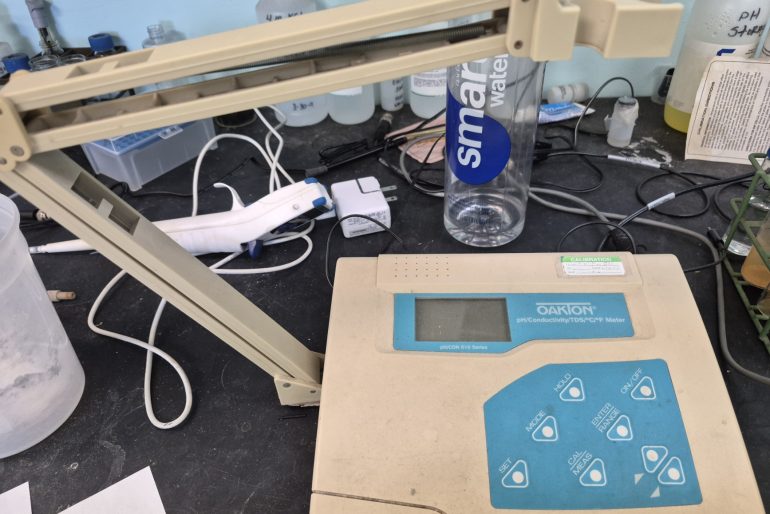
Sterling Analytical utilizes advanced benchtop meters with temperature-compensated electrodes to ensure that every measurement is corrected to standard reference conditions (typically 25°C).
Precision pH Analysis
pH is a logarithmic scale; a shift of one unit represents a tenfold change in acidity. Our laboratory provides the resolution needed to detect even minor fluctuations that could indicate process failure or environmental stress.
Electrometric pH (EPA 150.1 / ASTM D1293): The gold standard for pH measurement. We utilize high-stability glass electrodes and multi-point calibration to ensure accuracy across the entire 0–14 scale.
Soil pH (ASTM D4972): Using both water and calcium chloride (CaCl2) extraction methods to determine the “active” and “reserve” acidity of soil samples, critical for agriculture and corrosion engineering.
Non-Aqueous pH: Specialized testing for oils, solvents, and hydrocarbons where standard water-based electrodes cannot function.
Buffering Capacity & Titratable Acidity: Going beyond simple pH to determine how much acid or base is required to shift the pH, essential for wastewater neutralization systems.
Electrical Conductivity (EC) & TDS Analysis
Conductivity is the “early warning system” for water quality changes. An unexplained spike in conductivity often signals a leak, a chemical spill, or an increase in dissolved pollutants.
Specific Conductance (EPA 120.1 / ASTM D1125): Measurement of the electrical conductivity of water corrected to 25°C. This is a primary metric for monitoring groundwater salinity and industrial discharge.
Total Dissolved Solids (TDS) by Conductivity: Utilizing site-specific conversion factors to provide a rapid estimate of the total mineral content in a solution.
Salinity Analysis: Critical for coastal environmental monitoring and cooling tower management, measuring the salt concentration in parts per thousand (ppt).
Resistivity Testing: The inverse of conductivity, used primarily in the power and semiconductor industries to verify the purity of deionized (DI) or ultrapure water.
Why pH and Conductivity Matter
These parameters are more than just numbers on a report; they are critical variables in the safety and efficiency of industrial and natural systems.
1. Industrial Process and Boiler Management
In high-pressure boiler systems, pH must be strictly maintained (usually between 8.5 and 9.5) to prevent the rapid corrosion of steel components. Simultaneously, conductivity is monitored to manage “blowdown” cycles. If conductivity becomes too high, dissolved solids will precipitate, forming scale that destroys heat transfer efficiency and leads to tube failure.
2. Wastewater Compliance and Neutralization
Most NPDES (National Pollutant Discharge Elimination System) permits have strict pH limits (typically 6.0 to 9.0). Discharging water outside this range can kill aquatic life and result in massive fines. Our lab provides the verified data needed to calibrate on-site neutralization systems and prove compliance to regulators.
3. Soil Health and Nutrient Availability
In agriculture and land remediation, pH is the “gatekeeper” of nutrients. If soil pH is too low (acidic), essential nutrients like phosphorus become “locked” and unavailable to plants, while toxic metals like aluminum become soluble. Conductivity testing in soil (ECe) is used to manage salinity, preventing “salt burn” in crops.
4. Environmental Forensic Analysis
In groundwater monitoring, a change in conductivity is often the first sign of a contaminant plume moving through an aquifer. By mapping conductivity and pH across multiple monitoring wells, environmental engineers can track the movement of pollutants without performing expensive organic scans on every sample.
The Sterling Standard
We don’t just “dip a probe.” Our wet chemistry department follows a rigorous Quality Assurance (QA) protocol:
Temperature Compensation: All meters utilize Automatic Temperature Compensation (ATC) because conductivity changes by approximately 2% per degree Celsius.
Multi-Point Calibration: pH meters are calibrated daily using NIST-traceable buffers at pH 4, 7, and 10 to ensure linearity.
Probe Maintenance: Electrodes are cleaned and conditioned between every sample to prevent “memory effects” or cross-contamination.
Duplicate Testing: 10% of all samples are run in duplicate to verify precision and instrument stability.
Problems Identified
Through pH and conductivity analysis, we frequently identify:
Acid Mine Drainage: Characterized by extremely low pH and high conductivity due to dissolved metals.
Cooling Tower Scaling: High conductivity indicating a failure in the water treatment chemical program.
Groundwater Saltwater Intrusion: Rising conductivity levels in coastal drinking water wells.
Incomplete Neutralization: pH levels in industrial discharge that fluctuate outside of permit limits.
Deionized Water Breakthrough: Rising conductivity in high-purity water loops indicating exhausted resin beds.
Who Needs pH & Conductivity Testing?
Facility Managers: Monitoring cooling towers, boilers, and closed-loop HVAC systems.
Wastewater Operators: Ensuring compliance with municipal and industrial discharge permits.
Environmental Consultants: Conducting Phase II ESAs and groundwater monitoring programs.
Agricultural Producers: Managing soil fertility and irrigation water quality.
Food & Beverage Manufacturers: Maintaining product consistency and cleaning-in-place (CIP) effectiveness.
Construction Firms: Testing water for concrete mixing and soil for corrosivity.
How to Submit a Liquid Sample
Use Clean Containers: Use high-density polyethylene (HDPE) or glass bottles. We provide pre-cleaned, 250mL sample bottles upon request.
Zero Headspace: For pH testing, fill the bottle to the very top to minimize CO2 exchange with the air, which can shift the pH.
No Preservation Required: Unlike metals or organics, pH and conductivity samples should not be chemically preserved, as acids or bases will destroy the sample’s integrity.
Cooling: Keep samples at 4°C during transport to minimize biological activity that could alter the chemistry.
Short Hold Times: pH is a “short hold time” parameter. For regulatory compliance, samples should be analyzed as soon as possible (ideally within 24-48 hours).
Schedule pH & Conductivity Analysis Today
Water and soil quality begins with accurate measurement. Without proper pH and conductivity analysis, hidden imbalances and dissolved contaminants can go unnoticed, leading to corrosion, scaling, and system inefficiencies.
Sterling Analytical provides precise laboratory-based pH and conductivity testing to evaluate chemical balance, detect ionic activity, and support environmental monitoring and regulatory compliance
Frequently Asked Questions
Generally, no. Most regulatory permits require analysis by a certified laboratory using calibrated benchtop equipment and documented QA/QC procedures.
Conductivity is a measurement of electrical flow. TDS (Total Dissolved Solids) is the actual mass of minerals. While they are related, the "conversion factor" changes depending on whether the minerals are mostly sodium chloride, calcium carbonate, or sulfates.
If a sample is exposed to air, it can absorb or release Carbon Dioxide (CO2), which forms carbonic acid and changes the pH. This is why "Zero Headspace" and rapid shipping are critical.
Not necessarily. Seawater has very high conductivity (~50,000 µS/cm) but is a natural environment. "Bad" conductivity is a measurement that deviates significantly from the established baseline for your specific site or process
Quick Contact
If you have any questions or need help, feel free to contact with our team.
Send Us Email:
Call Us Today: