Landline Phone:
(413) 214-6541
Location:
15 Agawam Ave West Springfield, MA 01089
Mon - Fri:
8.00am - 4.00pm
Hydraulic Oil Analysis: Protecting the Heart of Fluid Power
In industrial manufacturing, construction, and aerospace, hydraulic systems are the “muscles” of the operation. Unlike an engine, where the oil must contend with combustion byproducts, a hydraulic system operates under extreme pressure—often exceeding 3,000 to 5,000 PSI. At these pressures, the lubricant is not just a protector; it is the medium through which power is transmitted.
Hydraulic Oil Analysis is a specialized discipline within our Oil Analysis Laboratory. Because hydraulic components like servo-valves and high-pressure piston pumps have incredibly tight tolerances (often less than 5 microns), even microscopic contamination can lead to “stiction,” erratic movement, or catastrophic pump seizure.
At Sterling Analytical, our hydraulic testing suite goes beyond standard UOA (Used Oil Analysis). We focus on the “Cleanliness” of the fluid, ensuring that your hydraulic power units (HPUs) remain reliable and efficient.
1. ISO 4406 Cleanliness: The Gold Standard
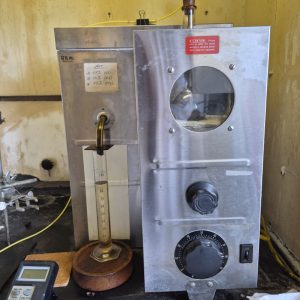
The most critical metric in any hydraulic oil report is the ISO 4406 Cleanliness Code. This code provides a standardized way to express the level of particulate contamination in a fluid.
Understanding the 3-Digit Code (e.g., 18/16/13)
The ISO code represents the number of particles per milliliter of fluid at three specific size ranges:
- First Number (>4 microns): Represents the total “silt” or fine particles.
- Second Number (>6 microns): Represents the “clearance-size” particles that cause the most wear in valves and pumps.
- Third Number (>14 microns): Represents the larger “debris” particles that can cause immediate mechanical damage.
Each increase in a single digit represents a doubling of the particle count. For example, an ISO code of 19/17/14 has twice as many particles as an 18/16/13.
Why It Matters
Most hydraulic component manufacturers specify a maximum ISO cleanliness level for warranty purposes. A high-pressure system with sensitive servo-valves may require a code of 15/13/10, while a rugged mobile excavator might tolerate 18/16/13. Operating outside these limits leads to “accelerated wear,” where particles act as an abrasive, grinding away the internal surfaces of the system.
2. Particle Counting Technology: Laser vs. Pore Blockage
At Sterling Analytical, we utilize two primary methods for determining the ISO code, depending on the condition of the oil.
Automatic Optical Particle Counting (APC)
Using a high-precision laser, the APC counts and sizes every particle as the oil flows through a sensing cell. This is the most accurate method for “clean” hydraulic fluids. However, lasers can be “fooled” by:
Entrained Air: Micro-bubbles can be miscounted as particles.
Free Water: Water droplets can also be seen as solid contaminants.
Pore Blockage Method
If a sample is “dark” or contains high levels of water/air, we utilize the Pore Blockage method. The oil is pushed through a calibrated mesh screen. As the screen clogs, the pressure drop is measured, and a mathematical algorithm calculates the particle distribution. This method is essential for “real-world” industrial samples that aren’t perfectly clear.
3. Water Contamination: The "Silent Killer" of Hydraulics
Water is particularly dangerous in hydraulic systems. While an engine can “boil off” small amounts of water, hydraulic systems often run at lower temperatures, allowing water to remain in the fluid.
Loss of Lubricity: Water has very low film strength. Under high pressure, the “water-oil” mix fails to protect metal surfaces, leading to scuffing and galling.
Valve Stiction: Water promotes the formation of “sludge” and “varnish.” This sticky residue accumulates on valve spools, causing them to lag or seize.
Pump Cavitation: Water vaporizes more easily than oil. These vapor bubbles collapse violently under pressure (cavitation), pitting the metal surfaces of the pump’s internal components.
Sterling Analytical uses Karl Fischer Titration (ASTM D6304) to detect water down to 10 ppm. For most hydraulic systems, we recommend keeping water levels below 500 ppm (0.05%).
4. Wear Metal Analysis in High-Pressure Systems
While particle counting tells us how “dirty” the oil is, Spectrometric Analysis (ICP) tells us what the machine is made of. In a hydraulic system, specific metals point to specific component failures:
Iron (Fe): Typically indicates wear in the pump (gears, vanes, or pistons) or the cylinder rods.
Copper (Cu): Found in the bronze bushings of pumps and the internal components of certain valves. High copper often precedes a total pump failure.
Aluminum (Al): Often comes from pump housings or certain types of high-speed motors.
Chromium (Cr): Indicates wear on the hard-chrome plating of hydraulic cylinder rods. If chromium is high, it often means the rod seals are failing, allowing dirt to enter the system.
By monitoring these metals alongside the ISO code, we can determine if the “dirt” in the system is external (sand/dust) or internal (metal wear debris).
5. Additive Health: Anti-Wear (AW) Packages
Additive Depletion: Over time, these additives are “used up” as they react with metal surfaces.
Zinc-Free Oils: Some modern systems (especially those with silver-plated components) require “Ashless” or Zinc-Free hydraulic oils. Our laboratory verifies that the correct oil is being used, preventing “additive clashing” that can lead to filter plugging.
6. Varnish Potential and Membrane Patch Colorimetry (MPC)
In modern, high-efficiency hydraulic systems, a new threat has emerged: Varnish. Unlike the hard particles measured by an ISO code, varnish consists of “soft contaminants”—microscopic degradation products that are sub-micron in size (less than 0.5 microns).
Because these particles are so small, they pass right through standard filters and are invisible to traditional laser particle counters. However, they are chemically “sticky.” They plate out on cool metal surfaces, forming a golden-brown film that eventually hardens into a sandpaper-like “varnish.”
Membrane Patch Colorimetry (ASTM D7843)
We use a combination of UOA (Used Oil Analysis) data to determine if the oil is still chemically “fit for service.” To safely extend an interval, three conditions must be met:
At Sterling Analytical, we use the MPC Test to quantify varnish potential. We filter a specific volume of oil through a fine membrane and measure the “color” of the residue left behind using a spectrophotometer.
MPC ΔE < 15: Normal. The oil is stable.
MPC ΔE 15–30: Caution. Varnish precursors are accumulating.
MPC ΔE > 40: Critical. Varnish is likely actively plating out on valves and heat exchangers.
The Danger of Varnish: In a hydraulic system, varnish causes “servo-valve stiction.” A valve that should move in milliseconds starts to lag, leading to erratic machine behavior, overheating, and eventually, a total system shutdown.
7. Filter Patch Analysis (Micropatch)
While our ICP-OES scan tells us the “chemistry” of the wear and our particle counter tells us the “quantity,” Filter Patch Analysis tells us the “identity.”
Our laboratory technicians perform a “Micropatch” by vacuum-filtering the oil through a specialized membrane. We then examine the patch under a high-power microscope (up to 1000x magnification). This allows us to identify contaminants that don’t show up on a standard elemental scan:
Seal Material: Small bits of rubber or Viton indicate failing O-rings or cylinder seals.
Fibers: Usually from low-quality filter media or rags used during maintenance.
Environmental Dust: Identifying specific types of sand or coal dust can help pinpoint where the system’s breathers are failing.
Large Wear Debris: Identifying “fatigue flakes” or “cutting wear” that are too large for the ICP to “see.”
8. The Economic Impact: ROI of Hydraulic Oil Analysis
The return on investment (ROI) for a hydraulic oil analysis program is often higher than any other maintenance activity.
Energy Efficiency and Volumetric Efficiency
A hydraulic pump is designed to move a specific volume of oil. As internal components wear—even at a microscopic level—oil begins to “leak” internally from the high-pressure side to the low-pressure side. This is called a loss of Volumetric Efficiency.
The Result: The pump has to work harder and run longer to perform the same task, consuming more electricity or fuel.
The Solution: By maintaining “Super Clean” oil (low ISO codes), you minimize internal leakage and can reduce energy costs by 5% to 15% over the life of the machine.
Avoiding "The Chain Reaction of Failure"
In a hydraulic system, the pump is the most expensive component. When a pump begins to fail, it “sheds” metal particles into the oil. If the system isn’t monitored, these particles travel downstream, destroying valves, cylinders, and motors. A $20,000 pump failure can quickly become a $100,000 total system overhaul. Hydraulic Oil Analysis catches the pump failure in its infancy, allowing you to flush the system and replace only the pump.
9. Sampling Protocols for Hydraulic Systems
To get an accurate ISO Cleanliness Code, the sampling process must be flawless. Hydraulic systems are extremely sensitive to “tramp” contamination introduced during sampling.
1. Use High-Pressure Sampling Valves: Ideally, samples should be taken from a “Minimess” style sampling port located on the return line before the filter. This provides a representative look at the “work” the oil has done.
2. The “Turbulent Flow” Rule: Never sample from a “dead leg” or a stagnant part of the reservoir. The oil must be in a state of turbulent flow to ensure particles are properly suspended.
3. Ultra-Clean Bottles: For hydraulic analysis, standard “clean” bottles are not enough. Sterling Analytical provides “Certified Ultra-Clean” bottles (ISO Class 100) to ensure that the bottle itself doesn’t add to the particle count.
4. Flush, Flush, Flush: You must flush at least 5 to 10 times the volume of the sampling line before taking the actual sample.
Integrated Oil Analysis Suite
Hydraulic health is a component of a total reliability strategy. Explore our other laboratory services:
UOA (Used Oil Analysis): The foundational test for all industrial lubricants.
Engine & Motor Oil Analysis: Specialized testing for the prime movers that drive your hydraulic pumps.
Transformer Oil Sample Analysis: Critical testing for electrical infrastructure, focusing on dielectric strength and dissolved gas analysis (DGA).
Frequently Asked Questions
For critical industrial HPUs (Hydraulic Power Units), we recommend quarterly testing. For mobile equipment (construction/mining), every 500 hours is the industry standard.
While some older equipment was designed for this, modern high-pressure hydraulics require specific Anti-Wear (AW) or R&O (Rust & Oxidation) oils. Engine oils contain detergents that can hold water in suspension, which is the opposite of what you want in a hydraulic system.
Stiction is a portmanteau of "Static Friction." It refers to a valve spool that gets "stuck" in place due to varnish or fine silt. It causes jerky, unpredictable machine movements.
This usually means the contamination is External. Sand, dust, or moisture is entering through a faulty breather or seal. The particles are there (high ISO), but they haven't had enough time to cause significant metal wear (low ICP) yet. This is the "Golden Window" for maintenance.
Quick Contact
If you have any questions or need help, feel free to contact with our team.
Send Us Email:
Call Us Today: