Landline Phone:
(413) 214-6541
Location:
15 Agawam Ave West Springfield, MA 01089
Mon - Fri:
8.00am - 4.00pm
Total Solids & Volatile Content Analysis Services
Related Posts
Sterling Analytical provides comprehensive Total Solids (TS) and Volatile Content analysis for water, wastewater, sludge, and industrial process streams. These gravimetric measurements are the primary tools used by engineers and operators to quantify the physical “load” within a liquid system. Whether you are managing a municipal wastewater treatment plant, optimizing an anaerobic digester, or monitoring industrial effluent for permit compliance, accurate solids data is essential for operational efficiency and environmental protection.
Our laboratory utilizes standardized gravimetric techniques—primarily the Standard Methods 2540 series and EPA Method 160.4—to provide a precise breakdown of the dissolved, suspended, and organic fractions within your samples. If you are searching for a solids testing laboratory near me to support NPDES permit reporting or process troubleshooting, Sterling Analytical offers the technical precision and rapid turnaround times required to manage complex waste streams effectively.
Understanding the “solids profile” of a sample involves more than just a single number. It requires a tiered analytical approach that separates the inorganic minerals from the organic biomass and the floating particles from the dissolved salts. Our laboratory-based solids analysis programs provide the “mass balance” data needed to optimize chemical dosing, calculate sludge age, and ensure that discharged water meets the stringent requirements of the Clean Water Act.
Our Solids & Volatile Content Testing Capabilities
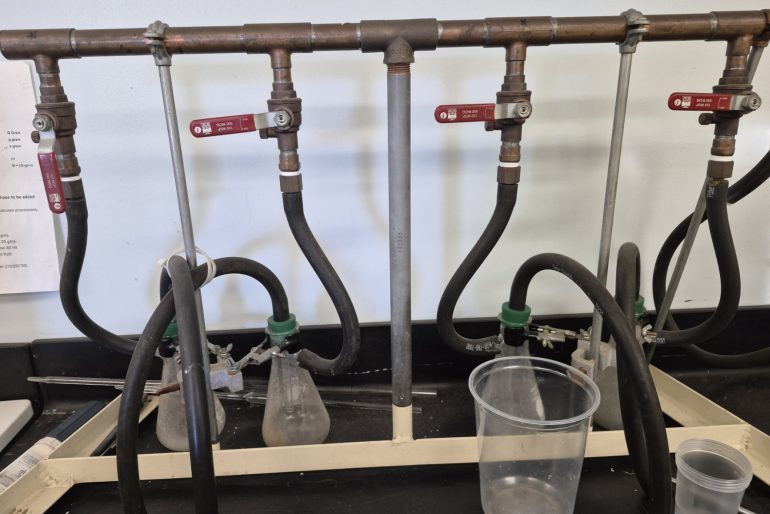
Sterling Analytical utilizes high-precision analytical balances and temperature-controlled drying ovens and muffle furnaces to provide a complete solids characterization.
Core Solids Analysis Suite
The core suite focuses on the physical separation and quantification of material based on size and solubility.
Total Solids (TS) – SM 2540B: The total residue remaining in a vessel after evaporation and drying at 103–105°C. This represents the sum of all dissolved and suspended material.
Total Suspended Solids (TSS) – SM 2540D: The portion of total solids retained by a filter (typically 1.5 µm pore size). High TSS levels increase turbidity and can carry heavy metals and pathogens into receiving waters.
Total Dissolved Solids (TDS) – SM 2540C: The portion of solids that passes through the filter and remains after evaporation. TDS is a primary indicator of mineral content and salinity
Settleable Solids – SM 2540F: Measured using an Imhoff cone, this identifies the volume of solids that will sink to the bottom of a tank over a 60-minute period, essential for primary clarifier design.
Volatile & Fixed Content (Organic vs. Inorganic)
By subjecting the dried solids to extreme heat (550°C), we can differentiate between the organic (volatile) and inorganic (fixed) fractions.
Total Volatile Solids (TVS) – SM 2540E: The weight loss of the total solids residue after ignition at 550°C. This represents the organic fraction of the sample, including bacteria, plant matter, and synthetic organics.
Volatile Suspended Solids (VSS): Specifically measures the organic portion of the suspended material. In wastewater treatment, VSS is often used as a surrogate measurement for the “active biomass” or “living” part of the sludge.
Fixed Total/Suspended Solids: The “ash” or mineral residue remaining after ignition. This represents the non-combustible material, such as silt, sand, and dissolved minerals.
Percent Volatile Solids Reduction (%VSR): A critical calculation for anaerobic digestion, determining how effectively the digester is breaking down organic waste into biogas.
The Engineering Importance of Solids Analysis
Solids analysis is the “pulse” of environmental engineering, influencing every stage of the water cycle.
1. Wastewater Treatment Process Control
In the activated sludge process, operators must maintain a specific concentration of “Mixed Liquor Suspended Solids” (MLSS). If the MLSS is too low, there aren’t enough microbes to treat the waste; if it’s too high, the clarifiers will overflow. Our VSS testing helps operators distinguish between the “active” microbes and the “dead” inorganic grit, allowing for precise control of the Mean Cell Residence Time (MCRT).
2. Sludge Management and Dewatering
Sludge disposal is often the most expensive part of wastewater treatment. By knowing the Total Solids percentage, managers can determine the efficiency of their dewatering equipment (belt presses, centrifuges). A shift from 2% solids to 4% solids effectively cuts the volume of sludge to be hauled in half, leading to massive operational savings.
3. Anaerobic Digestion and Biogas Production
For facilities utilizing anaerobic digesters to produce energy, Volatile Solids (VS) is the “fuel.” Our laboratory testing monitors the VS loading rate to prevent “sour” digesters and ensures that the final “Class A” or “Class B” biosolids meet the EPA 503 regulations for organic matter reduction.
4. Industrial Effluent and Surcharges
Many municipalities charge industrial users “surcharges” based on the TSS concentration of their discharge. Accurate, third-party laboratory verification from Sterling Analytical ensures that you are only paying for the solids you actually discharge, preventing overbilling by municipal authorities.
Compliance Overview
Solids testing is a cornerstone of regulatory compliance. Our laboratory procedures support the NPDES (National Pollutant Discharge Elimination System) reporting requirements under the Clean Water Act. We also provide testing for EPA Part 503 Biosolids Rule compliance, ensuring that treated sewage sludge meets the “Vector Attraction Reduction” (VAR) requirements through documented volatile solids reduction. For industrial clients, our data supports Pretreatment Program compliance and Stormwater Pollution Prevention Plans (SWPPP).
Problems Identified
Through solids and volatile analysis, we frequently identify:
Clarifier Bulking: High TSS in the effluent indicating that solids are not settling properly in the treatment plant.
Inorganic Grit Accumulation: Low VSS/TSS ratios in digesters indicating that sand and silt are taking up valuable tank volume.
Digester Overloading: Excessive volatile solids loading that can lead to organic acid buildup and process failure.
Filter Breakthrough: Rising TDS or TSS in industrial process water indicating that filtration or RO membranes are failing.
Inaccurate Surcharge Billing: Discrepancies between municipal “grab samples” and our composite solids analysis.
Who Needs Total Solids & Volatile Testing?
Municipal Wastewater Plants: Managing MLSS, VSS, and sludge dewatering processes.
Food & Beverage Processors: Monitoring high-strength organic waste (BOD/TSS) before discharge.
Pulp & Paper Mills: Managing large volumes of fiber-based suspended solids.
Landfill Operators: Analyzing leachate for total dissolved and suspended solids.
Environmental Consultants: Assessing the impact of sediment runoff in rivers and streams.
Agricultural Operations: Analyzing manure and lagoon solids for nutrient management and composting.
How to Submit a Solids Sample
Sample Volume: Provide a minimum of 500mL to 1L of liquid. For thick sludge or cake, 250g is usually sufficient.
Representative Sampling: Solids settle quickly. Ensure the sample is well-mixed and “representative” of the entire flow or tank.
Container Type: Use clean plastic (HDPE) or glass bottles.
Preservation: No chemical preservation is required, but samples must be cooled to 4°C immediately after collection to prevent biological degradation of the volatile fraction.
Hold Times: TSS and TDS have a regulatory hold time of 7 days, but for volatile solids (VS), we recommend analysis within 48 hours for the most accurate biological representation.
Schedule Total Solids & Volatile Content Analysis Today
Accurate material assessment starts with understanding its composition. Without proper total solids and volatile content analysis, critical information about moisture levels, organic matter, and residue can be overlooked—leading to inefficiencies, compliance issues, and process failures.
Sterling Analytical delivers precise laboratory-based total solids and volatile content testing to evaluate material composition, measure organic and inorganic fractions, and support environmental monitoring and regulatory compliance programs.
Frequently Asked Questions
Turbidity is an optical measurement of how light scatters through water. TSS is a gravimetric measurement of the actual weight of the particles. While they are related, TSS is the required metric for regulatory mass-balance calculations.
Volatile solids represent the organic portion that can be biologically degraded or burned. It is a measure of the "potential energy" in the sludge and the effectiveness of the treatment process.
Yes. In solid matrices, this is often referred to as the "Dry Matter" content. It is essential for calculating nutrient concentrations on a dry-weight basis.
High Total Dissolved Solids (TDS) lead to scaling in boilers, cooling towers, and pipes. It also increases the corrosivity of the water, potentially damaging metal infrastructure.
Quick Contact
If you have any questions or need help, feel free to contact with our team.
Send Us Email:
Call Us Today: