Landline Phone:
(413) 214-6541
Location:
15 Agawam Ave West Springfield, MA 01089
Mon - Fri:
8.00am - 4.00pm
Sludge Ultimate Analysis (CHNS) Services
Related Posts
Sterling Analytical provides high-precision Sludge Ultimate Analysis (CHNS), offering a fundamental chemical breakdown of the elemental building blocks within wastewater residuals. While standard nutrient testing focuses on agricultural value, Ultimate Analysis is the essential tool for Waste-to-Energy (WTE) engineering, thermal processing, and advanced biological process modeling.
By quantifying the exact weight percentages of Carbon (C), Hydrogen (H), Nitrogen (N), and Sulfur (S), our laboratory empowers engineers and facility managers to calculate high-fidelity energy balances, predict atmospheric emissions, and optimize the stabilization of organic matter. Whether you are designing a state-of-the-art gasification plant, managing a municipal incinerator, or balancing a complex anaerobic digester, Sterling Analytical delivers the NIST-traceable data required for technical excellence.
In the modern landscape of “Resource Recovery,” sludge is no longer treated as a waste to be discarded but as a feedstock for energy. To unlock this potential, you must move beyond physical descriptions and into the elemental reality of the material. If you are searching for an elemental analysis lab near me to determine the fuel quality or biological stability of your residuals, Sterling Analytical offers the analytical rigor and rapid turnaround your project demands.
The Importance of Ultimate Analysis in Residuals Management
The “Ultimate Analysis” differs fundamentally from “Proximate Analysis.” While proximate analysis tells you how much moisture or ash is in a sample, Ultimate Analysis tells you what the sample is at a molecular level. This data is the foundation for three critical areas of modern sludge management:
1. Thermal Engineering and Calorific Value
For facilities utilizing sludge incineration, co-firing, or pyrolysis, the elemental composition dictates the “Higher Heating Value” (HHV). Carbon and Hydrogen are the primary energy drivers. Without precise CHNS data, engineers cannot accurately size blowers, design heat recovery systems, or predict the self-sustainment (autogenous) point of a furnace.
2. Biological Process Control (The C Ratio)
In anaerobic digestion and composting, the relationship between Carbon and Nitrogen is the “heartbeat” of the system. A C ratio that is out of balance can lead to ammonia toxicity (which kills methanogenic bacteria) or nutrient starvation (which halts decomposition). Ultimate analysis provides the most accurate “Total Carbon” and “Total Nitrogen” values for these calculations.
3. Environmental Emission Modeling
Regulatory permits for thermal processes require strict limits on Nitrogen Oxides (NOx) and Sulfur Dioxide (SO2). Because these pollutants are formed directly from the nitrogen and sulfur “bound” within the sludge, ultimate analysis allows facility managers to predict emissions and ensure that scrubbers and Selective Catalytic Reduction (SCR) systems are properly calibrated.
Our Core Elemental Analytical Capabilities
Sterling Analytical utilizes advanced automated combustion technology to provide a complete elemental fingerprint of sludge samples.
1. Total Carbon (C)
Carbon typically makes up 20% to 50% of the dry mass of sewage sludge.
Energy Density: Carbon is the primary fuel source. Our analysis distinguishes the total carbon load, which is used to calculate the carbon-to-energy conversion efficiency.
GHG Accounting: As carbon credit markets evolve, knowing the exact mass of biogenic carbon in your sludge is essential for Greenhouse Gas (GHG) inventory reporting.
2. Hydrogen (H)
Hydrogen is a high-energy element that contributes significantly to the net heat of combustion.
Net Energy Calculation: During combustion, hydrogen reacts with oxygen to form water vapor ($H_2O$). This reaction releases heat, but the subsequent evaporation of that water consumes energy. Our hydrogen data allows for the calculation of the Lower Heating Value (LHV)—the “real world” energy available to a boiler.
3. Total Nitrogen (N)
Unlike TKN (Total Kjeldahl Nitrogen) used in agriculture, CHNS Nitrogen captures all nitrogen forms, including those that might be missed by traditional wet chemistry.
Protein Content Estimation: In biological modeling, nitrogen is used as a proxy for protein content within the biomass.
Fuel NOx Prediction: Most NOx emissions from sludge incineration come from the nitrogen in the fuel, not the air. Accurate N-values are critical for Clean Air Act compliance.
4. Total Sulfur (S)
Sulfur is often a minor constituent by weight but a major driver of operational costs.
Corrosion Protection: Sulfur converts to $H_2S$ in digesters and $SO_2$ in incinerators. Both are highly corrosive to metal infrastructure and gas-fired engines.
Odor Management: Sulfur is the primary source of “nuisance odors” in biosolids management.
5. Oxygen (O) by Difference
Oxygen is essential for determining the “oxidation state” of the sludge. It is calculated by subtracting the sum of C, H, N, S, and Ash from 100%. This value is vital for determining the Stoichiometric Oxygen Requirement—the exact amount of air needed for “clean” combustion.
The Science of the Dumas Method
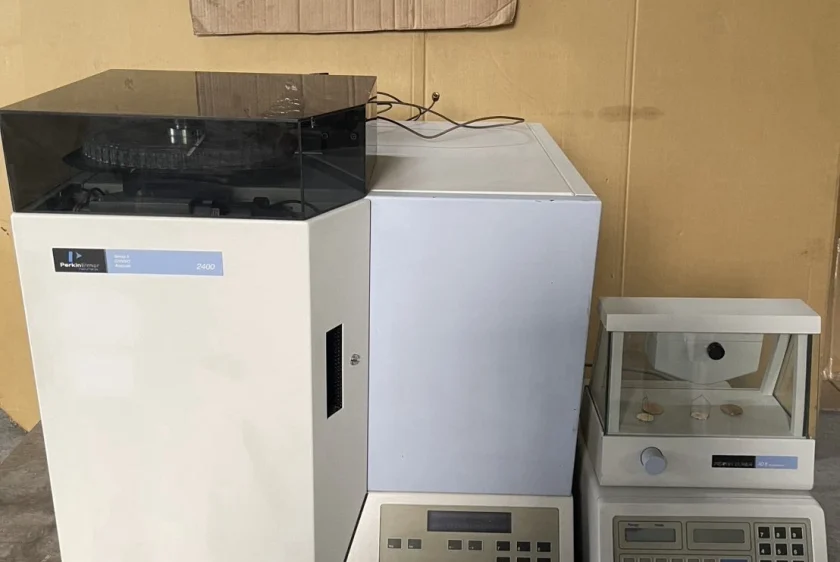
At Sterling Analytical, we treat elemental analysis as a high-temperature engineering process. We utilize the Modified Dumas Method, which provides superior accuracy over older wet-chemical techniques.
1. Flash Combustion (1,800°C)
The sludge sample is weighed into a tin or silver capsule and dropped into a combustion chamber filled with pure oxygen. The tin reacts exothermically, creating a “flash” that raises the local temperature to nearly 1,800°C. This ensures that even the most thermally stable organic compounds and “refractory” carbon are completely oxidized into gases ($CO_2$, $H_2O$, $N_2$, $SO_2$).
2. The Reduction Phase
The resulting gas stream is passed over a bed of high-purity copper or tungsten. This stage serves two purposes: it removes any excess oxygen and reduces nitrogen oxides ($NO_x$) back into elemental nitrogen ($N_2$), which can then be accurately measured.
3. Thermal Conductivity Detection (TCD)
The individual gases are separated using a gas chromatography (GC) column and passed through a Thermal Conductivity Detector. This detector measures the change in the thermal properties of the carrier gas (Helium or Argon) as the sample gases pass through. Because each element corresponds to a specific gas peak, we can quantify the mass of C, H, N, and S with four-decimal-place precision.
Engineering Impact: Sludge Chemistry and Process Design
1. Maximizing Biogas Yield
For anaerobic digestion, the “Theoretical Methane Potential” (TMP) is calculated using the elemental composition of the feedstock (the Buswell Equation). By knowing the C, H, N, O, and S content, Sterling Analytical helps operators determine if their digesters are underperforming relative to their chemical potential.
2. Incineration and Ash Management
The relationship between Carbon and Ash content determines the “Volatile Solids” (VS) of the sludge. High-carbon, low-ash sludge is ideal for incineration. Conversely, if the CHNS analysis shows low carbon but high sulfur, the facility may face “slagging” issues, where the ash melts and fuses to the furnace walls, leading to expensive maintenance shutdowns.
3. Pyrolysis and Biochar Quality
For anaerobic digestion, the “Theoretical Methane Potential” (TMP) is calculated using the elemental composition of the feedstock (the Buswell Equation). By knowing the C, H, N, O, and S content, Sterling Analytical helps operators determine if their digesters are underperforming relative to their chemical potential.
Compliance and Quality Assurance
Sterling Analytical adheres to the strictest international frameworks for elemental analysis:
ASTM D5373: The standard test method for instrumental determination of Carbon, Hydrogen, and Nitrogen in solid samples.
ASTM D4239: Specifically for the determination of Sulfur in high-temperature combustion environments.
ISO 16948: International standards for the ultimate analysis of solid biofuels and residuals.
NIST Traceability: Our instruments are calibrated daily using NIST-certified organic standards (such as Acetanilide or Sulfanilamide) to ensure that your data is legally defensible.
Problems Identified
Through CHNS Ultimate Analysis, we frequently identify:
Ammonia Toxicity Risk: Low C ratios (<10:1) in digesters that lead to process “souring.”
Low Calorific Value: High oxygen or ash content that makes sludge unsuitable for energy recovery without supplemental fuel.
Corrosion Potential: Unexpectedly high sulfur levels that would destroy co-generation gas engines.
Incomplete Stabilization: High hydrogen-to-carbon ratios indicating that the sludge still contains “raw” organic matter that will cause odor issues.
Who Needs Sludge Ultimate Analysis?
Waste-to-Energy (WTE) Plant Managers: Sizing equipment and modeling energy output.
Anaerobic Digester Operators: Balancing feedstocks (FOG, food waste, and sludge) for maximum methane.
Environmental Consultants: Calculating GHG footprints and carbon sequestration potential.
Incinerator Operators: Predicting NOx and SO2 emissions for permit compliance.
Research Universities: Studying the chemical transformation of biosolids during thermal treatment.
How to Submit a Sample
Sample Volume: Provide at least 250g to 500g of dewatered cake or 1 Liter of liquid sludge.
Although the CHNS instrument uses only milligrams, a larger bulk sample is required to ensure the laboratory can perform proper drying and homogenization to achieve a representative sub-sample.
Container: Use wide-mouth HDPE (High-Density Polyethylene) or glass jars. Ensure the lids are airtight to prevent the loss of volatile organic components or the absorption of atmospheric moisture.
Preservation: Samples should be cooled to 4°C immediately after collection and maintained at this temperature during transport. No chemical preservatives (like acid) should be added, as these will alter the elemental Carbon, Nitrogen, and Sulfur concentrations.
Representativeness: Because CHNS analysis is performed on a microscopic scale (often <10mg), the “heterogeneity” of sludge is the greatest source of error. We recommend taking multiple “grab” samples from different points in the process and compositing them into a single container to provide a true “facility average.”
Documentation: Clearly indicate if the sample is “Raw,” “Digested,” or “Composted,” as this helps our technicians optimize the combustion furnace parameters for your specific matrix.
Unlock Elemental Insights from Your Sludge & Biosolids
Sterling Analytical delivers high-precision CHNS Ultimate Analysis to quantify Carbon, Hydrogen, Nitrogen, and Sulfur in wastewater residuals. Our data empowers WTE engineers, anaerobic digester operators, and thermal process designers to optimize energy recovery, predict emissions, and improve process stability—ensuring compliance, efficiency, and sustainability.
Take the next step with expert laboratory support:
Frequently Asked Questions
Proximate analysis measures the physical behavior of the sludge (Moisture, Volatile Matter, Fixed Carbon, and Ash). Ultimate Analysis (CHNS) measures the chemical elements (Carbon, Hydrogen, Nitrogen, Sulfur, and Oxygen). You need both to perform a complete energy balance for an incinerator or gasifier.
Not exactly. Total Kjeldahl Nitrogen (TKN) measures organic nitrogen and ammonia. CHNS Nitrogen is a "True Total" nitrogen—it includes everything in TKN plus nitrates ($NO_3$) and nitrites ($NO_2$). For most sewage sludges, the values are very close, but CHNS is the preferred metric for combustion and mass-balance engineering.
Engineers use the Dulong Formula or the Steuer Formula, which inputs the percentages of C, H, S, and O to estimate the Higher Heating Value (HHV). This allows you to determine if your sludge is "autogenous" (can burn on its own) or if it requires supplemental natural gas.
Direct measurement of oxygen is technically difficult and expensive because oxygen is present in almost all combustion gases. By subtracting the measured percentages of C, H, N, S, and Ash from 100%, we arrive at the oxygen content. This is the industry-standard approach for sludge and coal characterization.
If your CHNS report shows high sulfur, your biogas will likely have high $H_2S$ levels. This alerts you to the need for iron sponge filters or biological scrubbers to protect your co-generation engines from "acid pitting" and catastrophic failure.
Quick Contact
If you have any questions or need help, feel free to contact with our team.
Send Us Email:
Call Us Today: