Landline Phone:
(413) 214-6541
Location:
15 Agawam Ave West Springfield, MA 01089
Mon - Fri:
8.00am - 4.00pm
Material Chemical Resistance (ASTM D543)
Related Posts
In the world of Material Compatibility Testing, ASTM D543 is the definitive standard for evaluating how “Plastics” (including elastomers and composites) respond to chemical reagents. Whether you are developing a new medical device, an automotive fuel line, or an industrial storage tank, understanding the chemical resistance of your polymer is critical for safety and performance.
Sterling Analytical provides comprehensive ASTM D543 testing, offering both Practice A (Immersion) and Practice B (Environmental Stress Cracking) to simulate real-world exposure conditions.
The Two Methodologies of ASTM D543
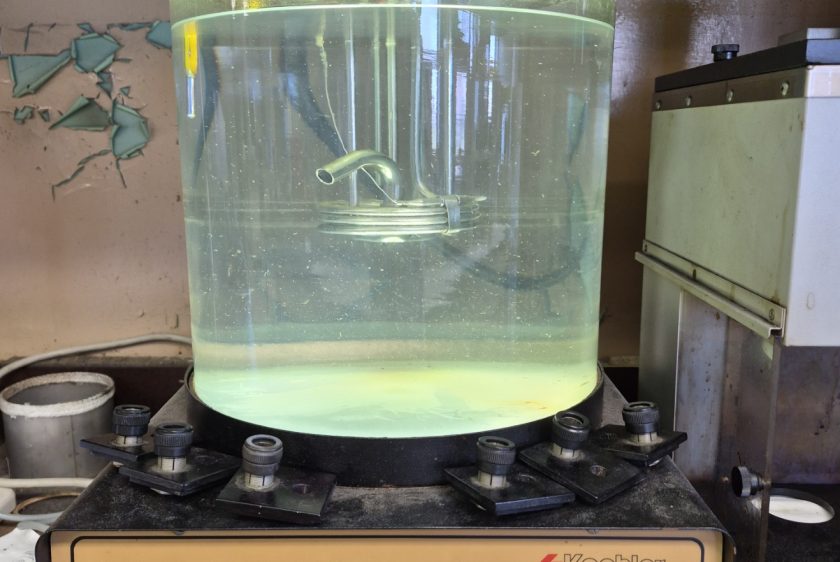
Practice A: Immersion Testing
This is the most common form of testing. The material is fully submerged in the test reagent for a specified duration (typically 7 days) at a controlled temperature.
Key Metrics: Change in weight, change in dimensions (thickness/width), and change in appearance (discoloration, crazing, or loss of gloss).
Practice B: Applied Stress (Environmental Stress Cracking)
Many materials are “chemically resistant” when sitting on a shelf, but fail immediately when they are under mechanical tension.
The Test: The material is placed under a specific strain (bent over a mandrel) and then exposed to the chemical.
The Goal: To identify Environmental Stress Cracking (ESC), where the chemical accelerates the formation of microscopic cracks, leading to sudden, brittle failure.
Critical Evaluation Metrics
A “Pass/Fail” result is rarely enough for engineering. Sterling Analytical provides quantitative data across three dimensions:
- Mass & Dimensional Stability: We use high-precision analytical balances to measure weight changes to the nearest 0.1mg. Swelling of >3% is often considered a failure for sealing applications.
- Mechanical Property Retention: After immersion, we perform tensile or flexural testing. We compare the “Aged” samples to “Control” samples. If the material loses more than 20% of its tensile strength, it is generally considered incompatible.
- Visual & Microscopic Analysis: We use high-resolution microscopy to look for “crazing”—the precursor to cracking—which is often invisible to the naked eye.
Common Reagents for ASTM D543
We maintain a library of standard reagents, but can also test with your proprietary process fluids:
Acids/Bases: Sulfuric Acid, Hydrochloric Acid, Sodium Hydroxide.
Solvents: Acetone, MEK, Toluene, Alcohols.
Automotive Fluids: Gasoline, Diesel, Brake Fluid, Coolants.
Cleaning Agents: Bleach, Quaternary Ammonium, Hydrogen Peroxide.
Submission Requirements
Specimens: Minimum of 5 specimens per reagent (plus 5 for the control).
Specimen Dimensions: Standard ASTM D638 (Tensile) or ASTM D790 (Flexural) “dog-bone” bars are preferred. If testing finished parts, please provide at least 3-5 identical components per reagent.
Reagent Volume: Provide at least 500mL of the test chemical. ASTM D543 requires a minimum ratio of reagent volume to specimen surface area to ensure the chemical concentration remains constant throughout the test.
Safety Documentation: A current Safety Data Sheet (SDS) must accompany all chemical reagents submitted to the lab.
Exposure Parameters: Clearly define the required temperature (e.g., 23°C ambient or 70°C accelerated) and duration (standard is 7 days/168 hours).
Why ASTM D543 is the Industry Standard
Unlike informal “soak tests,” ASTM D543 provides a standardized framework that allows engineers to compare materials from different global suppliers on an “apples-to-apples” basis.
Quantitative vs. Qualitative Data
Many field tests rely on a technician saying a material “looks okay.” Sterling Analytical removes the subjectivity:
- Mass Change: We use analytical balances with 0.1mg resolution to detect even microscopic levels of fluid absorption.
- Property Retention: We calculate the “Percentage Retention” of mechanical strength. For example: “Material X retained 92% of its tensile strength after 168 hours of exposure to Toluene.” This data is essential for safety factor calculations in structural engineering.
Engineering Impact: Preventing Environmental Stress Cracking (ESC)
Environmental Stress Cracking is one of the most common causes of plastic pipe and component failure. It occurs when a material is under “Stress” (mechanical load) and “Strain” (chemical exposure) simultaneously.
By utilizing Practice B of ASTM D543, Sterling Analytical can identify if your chosen polymer is susceptible to ESC. This is critical for:
Medical Devices: Ensuring housings don’t crack when cleaned with harsh disinfectants.
Automotive: Validating under-hood components exposed to oils and heat.
Industrial Piping: Confirming that gaskets and seals won’t fail under the combined pressure of the fluid and the chemical nature of the reagent.
Ensure Your Polymers Perform Safely Under Real-World Conditions
Sterling Analytical provides ASTM D543 testing to evaluate chemical resistance, mechanical property retention, and environmental stress cracking of plastics, elastomers, and composites. Our precise, quantitative data allows engineers to make informed decisions for medical devices, automotive components, industrial piping, and more.
Take the next step with expert material testing:
Frequently Asked Questions
The standard duration is 7 days (168 hours). However, for long-term service life predictions, we can extend testing to 30, 60, or 90 days.
Yes. Chemical reactions and absorption rates accelerate at higher temperatures. We frequently perform testing at 50°C, 70°C, or higher to simulate "worst-case" operating environments.
ASTM D543 does not set a universal "Pass/Fail" limit. Instead, the "Failure" is defined by your specific application. For a fuel tank, a 5% weight gain might be a failure; for a non-critical spacer, it might be acceptable. We provide the data; your engineering team sets the threshold.
No. ASTM D543 is specifically for plastics and polymers. For metals, we recommend our Metal Corrosion & Leaching (ICP-OES) service.
Quick Contact
If you have any questions or need help, feel free to contact with our team.
Send Us Email:
Call Us Today: